Wondering what makes Cheltenham feel so distinct from one block to the next? In a township of just over 9 square miles, you can trace centuries of local history through houses, civic landmarks, religious architecture, and preserved historic districts. If you love neighborhoods with character, or you are thinking about buying or selling in the area, this virtual walking tour will help you spot the details that shape Cheltenham’s identity. Let’s dive in.
Why Cheltenham’s Architecture Stands Out
Cheltenham Township dates to 1683 and was incorporated in 1900. The township describes itself as Philadelphia’s first suburb, and that history shows up in the built environment in layers rather than in one single look.
As you move through Cheltenham, you can see colonial-era structures, Civil War-era history, late-19th-century suburban development, and grand estate and institutional architecture. That mix is part of what gives the township its lasting visual appeal and strong sense of place.
The township also notes two National Register historic districts, La Mott and Wyncote. Together, they help tell a broader story about how Cheltenham developed over time and why its streetscapes still feel so memorable today.
Start With The Richard Wall House
If you want to begin at the earliest chapter, start with the Richard Wall House Museum in Elkins Park. Dated 1682, it is the township’s oldest structure and one of the oldest Quaker meeting houses still standing in America.
Located in Wall Park at Church Road and Wall Park Drive, the house gives your tour a strong foundation. It reminds you that Cheltenham’s architectural story starts long before rail suburbs and estate homes entered the picture.
For visitors, this is more than a drive-by landmark. The township notes that the museum is open on the fourth Sunday of most months from February through October, with appointments available at other times, and the Historical Commission also offers public bus and walking tours.
Explore La Mott’s Historic Layer
Next, shift to La Mott, where architecture and history are closely tied. The La Mott Historic District is bounded by Penrose Avenue, Graham Lane, Dennis Street, and Cheltenham Avenue, and it represents one of Cheltenham’s most important historic layers.
The township identifies La Mott as the site of Lucretia Mott’s home, Roadside, which was a stop on the Underground Railroad. It also identifies the area as the location of Camp William Penn, described locally as the first facility in the country built solely to train African-American recruits during the Civil War.
What makes La Mott especially meaningful is that the township also describes it as one of the first racially integrated suburban communities. For a walking or driving tour, that gives the district added depth because you are not just looking at buildings. You are looking at a neighborhood shaped by civic and social history as well.
Walk Wyncote For Classic Suburban Styles
If you picture Cheltenham as a place of tree-lined streets and vintage homes, Wyncote is likely a big part of that image. The Wyncote Historic District developed in the late 1880s through six different developers, and the township places it along Greenwood Avenue and between Washington Lane and Rices Mill Road, with broader boundaries near Glenview Avenue, the SEPTA rail line, Webster Avenue, and Church Road.
This is where you can see several architectural styles working together in one streetscape. The township says Queen Anne was the most common house style, with Second Empire, Colonial Revival, and Tudor Revival also present.
For buyers, homeowners, or architecture fans, Wyncote is useful because the style differences are often easy to spot once you know what to look for. You do not need to be an architect to recognize the patterns.
Queen Anne Details To Notice
Queen Anne homes are often the most playful and visually varied on the block. PHMC describes them as asymmetrical, with steep roofs, towers, expansive porches, and patterned wall surfaces.
When you walk through Wyncote, look for homes that feel less formal and more layered. A wraparound porch, varied textures, and a more complex roofline are often your first clues.
Colonial Revival Symmetry
Colonial Revival homes usually feel more balanced and orderly. PHMC describes the style as a return to Georgian and Federal symmetry, often with classical door surrounds, shutters, and dormers.
On the street, these homes can read as calm and composed. If a house feels centered, evenly arranged, and rooted in traditional proportions, you may be looking at Colonial Revival influences.
Tudor Revival Character
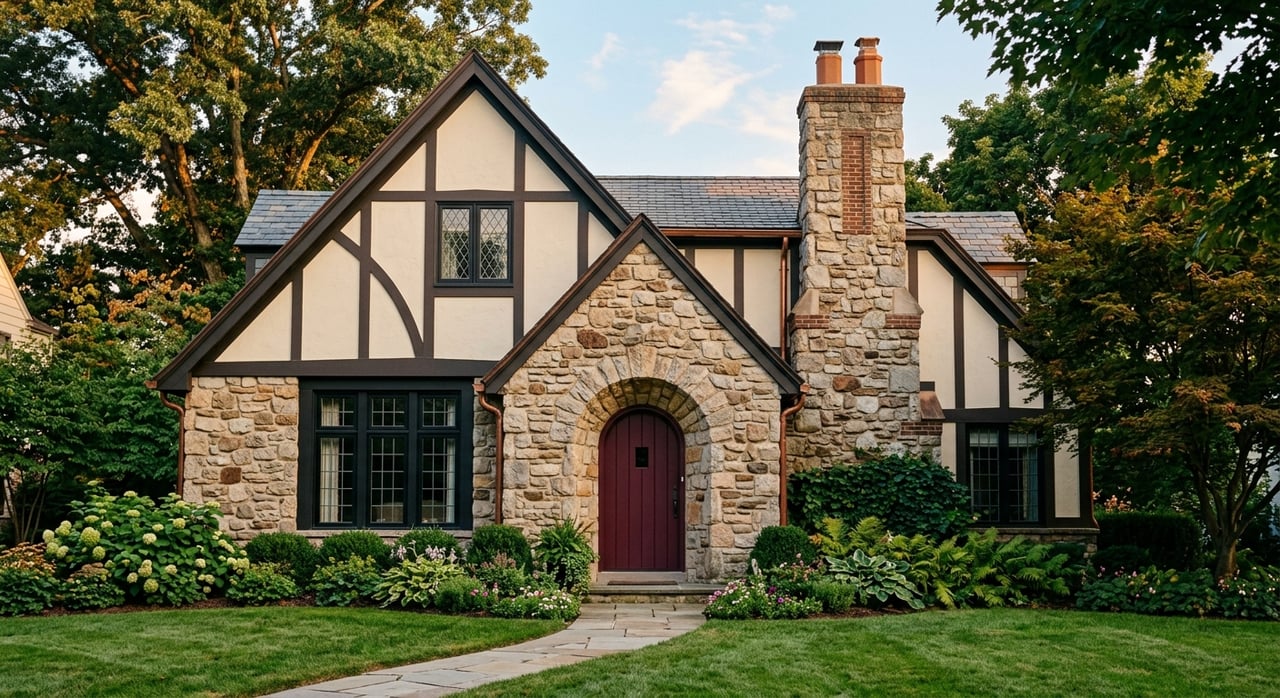
Tudor Revival brings a more storybook look to the streetscape. PHMC notes steep roofs, picturesque forms, half-timbering, and prominent chimneys as common features.
In Cheltenham, these homes often add contrast within a block of late-19th- and early-20th-century houses. They can feel especially eye-catching because of their strong rooflines and textured facades.
Second Empire Rooflines
Second Empire is one of the easiest styles to identify once you know the signature feature. PHMC points to the mansard roof, often paired with dormers and bracketed cornices.
If you see a home with a roof that creates an extra sense of height and a distinctive upper story, pause for a closer look. That roofline is often what sets the style apart.
Look Up At Gothic Influences
Cheltenham’s architecture is not just residential. In Wyncote and around its institutional landmarks, Gothic vocabulary helps explain some of the area’s most striking buildings.
PHMC describes Gothic Revival as emphasizing pointed arches, steep roofs, tracery, and sometimes castle-like towers. In neighborhood settings, those details often appear in churches and other prominent community buildings.
PHMC also notes that Collegiate Gothic adapts this medieval vocabulary for educational and campus settings. That makes it a helpful lens when you get to one of Cheltenham’s most dramatic landmarks, Grey Towers Castle.
Add Estate Architecture At Curtis Arboretum
Cheltenham’s story also includes grand estates that later took on civic life. Curtis Arboretum is a great example because it combines architecture, landscape, and public use in one stop.
The township describes Curtis Arboretum as the former estate of publishing magnate Cyrus H.K. Curtis. It also notes that Curtis Hall was once the estate’s music room and ballroom.
For your tour, this stop broadens the experience beyond house-by-house observation. It shows how land, buildings, and later public reuse can shape the feel of a community just as much as private homes do.
See Grey Towers Castle
Few buildings in Cheltenham make a stronger first impression than Grey Towers Castle. Arcadia says the castle was constructed between 1893 and 1898 for sugar-refining magnate William Welsh Harrison, with renovations by a 23-year-old Horace Trumbauer.
The design was inspired by Alnwick Castle in England, and Arcadia notes that the house had 40 rooms. It was declared a National Historic Landmark in 1985, which underscores its significance not just locally, but nationally.
This is one of the best places to appreciate Cheltenham’s estate-and-institution layer. Arcadia also notes that first-floor tours are offered on a scheduled basis, so this is a stop to plan ahead for rather than a casual drop-in.
Plan Ahead For Beth Sholom Synagogue
Beth Sholom Synagogue is another landmark that deserves a place on any Cheltenham architecture tour. The preservation organization identifies it as Frank Lloyd Wright’s only synagogue, and it is also recognized as a National Historic Landmark.
Because of its importance, this is best approached as a scheduled visit. The preservation organization says tours are by advance booking, with public tours generally offered on Sundays and weekday group or private tours available by arrangement.
For architecture lovers, this stop adds a completely different design voice to the tour. It also highlights how Cheltenham’s architectural identity extends beyond residential streets into nationally significant institutional design.
Pause At Glenside Memorial Hall
Glenside Memorial Hall makes a useful transition point in the tour. Built in 1926 to honor World War I veterans, it reflects a civic layer in Cheltenham’s built environment that connects neighborhood life with public memory.
As you move from older houses and historic districts toward larger landmarks, this stop helps tie the story together. It shows that Cheltenham’s classic architecture is not limited to private residences or estate grounds.
What Preservation Means For Homeowners
If you are exploring Cheltenham as a potential buyer or seller, preservation rules are worth understanding. The township’s ordinance says the historical districts are intended to protect historic places and areas of unique interest.
In those districts, exterior alterations, new construction, demolition, and many land development or subdivision changes require Certificate of Appropriateness review through the Board of Historical Architectural Review. The code also exempts routine repair and replacement in kind from that review.
In practical terms, that means historic character is actively considered in certain parts of the township. If you are drawn to a character home, it helps to understand both the charm and the added layer of review that may apply.
How To Enjoy The Tour
The best way to think about this route is as a virtual walking tour with a mix of exterior viewing, neighborhood strolling, and scheduled visits. Because access varies by site, you may want to combine a self-guided drive with one or two planned tours.
A simple approach could look like this:
- Start at the Richard Wall House for the colonial-era foundation
- Continue to La Mott for Civil War and abolition history
- Spend time in Wyncote looking at residential styles and streetscapes
- Stop by Curtis Arboretum for estate grounds and civic reuse
- Schedule Grey Towers Castle and Beth Sholom Synagogue in advance
- Use Glenside Memorial Hall as a civic landmark stop
That mix gives you a fuller sense of why Cheltenham matters. In a relatively compact township, you can experience centuries of design, planning, and community history without covering a huge geographic area.
Cheltenham’s architecture tells a story of continuity and change at the same time. If you are house hunting, preparing to sell, or simply learning the area, understanding these classic landmarks and districts can help you see what makes the township feel so established, layered, and distinctive.
If you want help understanding Cheltenham’s neighborhoods, character homes, and the local market, connect with Sean Ryan. You will get thoughtful, local guidance grounded in the communities that shape this part of Montgomery County.
FAQs
What architectural styles can you see in Cheltenham?
- In Cheltenham, the most recognizable residential styles include Queen Anne, Colonial Revival, Tudor Revival, and Second Empire, while Gothic Revival and Collegiate Gothic help explain churches and institutional buildings.
What is the oldest building in Cheltenham?
- The Richard Wall House Museum, dated 1682 in Elkins Park, is the township’s oldest structure according to Cheltenham Township.
Can you tour Cheltenham’s historic landmarks?
- Yes, but access varies. The Richard Wall House has regular open dates and appointments, while Grey Towers Castle and Beth Sholom Synagogue generally require scheduled tours.
Where is the Wyncote Historic District in Cheltenham?
- The township places the Wyncote Historic District along Greenwood Avenue and between Washington Lane and Rices Mill Road, with broader boundaries near Glenview Avenue, the SEPTA rail line, Webster Avenue, and Church Road.
What should homebuyers know about historic districts in Cheltenham?
- In Cheltenham’s historic districts, some exterior changes, new construction, demolition, and certain development changes may require Certificate of Appropriateness review, while routine repair and replacement in kind are exempt.
Why is La Mott important in Cheltenham history?
- La Mott is significant for its ties to Lucretia Mott, the Underground Railroad, Camp William Penn, and its history as one of the first racially integrated suburban communities identified by the township.