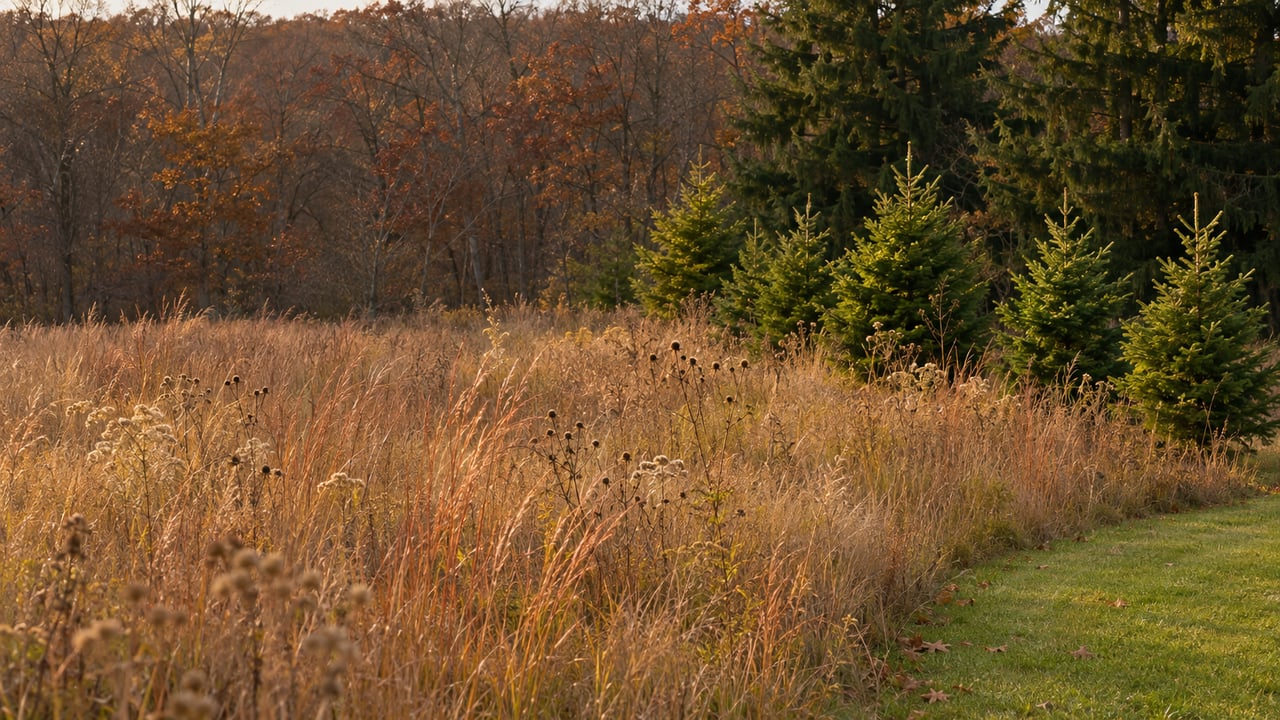
Walk in from the parking lot at 2955 Edge Hill Road during the last weeks of November and you'll find the grasslands tall and tan, with bluestem and switchgrass still standing well after they've browned. Near the Visitor Center, a dark row of spruces and pines blocks the wind, and the Trust called volunteers out on November 14 to plant more than 200 trees to reinforce it.
Two plans account for that late-fall look. One keeps the grass standing until late February. The other rebuilds a tree row that farmers planted here decades before the Trust owned the land.
The Tree Row Started as Farm Equipment
The conifers near the Trust's headquarters were planted to do a job. The Pennsylvania Horticultural Society calls the 2026 project there a shelterbelt restoration, and the Trust's own trail signs explain what a shelterbelt was meant to do.
The trail-sign series the Trust publishes for its self-guided hikes puts it plainly:
"Farming was in serious decline by the 1950's. One hallmark of the landscape under cultivation are shelter-belts. These lines of spruces and pines were promoted by the Soil Conservation Service as a way of reducing soil erosion and protecting homes and barns from heat loss."
Another sign in the same series dates the row by the house it protects, which is now the Trust's office. In a photo taken sometime after 1925, the conifers have not yet reached the roofline. In photos from 1945, the same trees stand far taller than the house. The signs also say shelterbelts like this one show up in several other spots around the preserve.
The row still does its original job. In its call for volunteers, the Trust described the conifer belt as protecting its buildings from wind and weather. The plan was to plant more than 200 trees near the Visitor Center to strengthen it, at a free volunteer session scheduled for Saturday, November 14, from 10 a.m. to noon. Farmers planted the row to keep their buildings warm, and a conservation nonprofit is now reinforcing it for the same reason.
Why a Watershed Grant Paid for Windbreak Trees
The money came from a program built around clean water. On May 5, 2026, the Pennsylvania Horticultural Society announced more than $276,000 in Trees for Watersheds grants across Southeastern Pennsylvania. The program funds planting in priority watershed areas to reduce polluted stormwater runoff and flooding and to improve stream health. The Pennypack Ecological Restoration Trust received $10,000 for its shelterbelt restoration, which PHS described as a project "to strengthen biodiversity and ecological resilience."
The grant ties the tree row back to its first purpose. The Soil Conservation Service backed shelterbelts to keep soil in place, and soil that stays on the land stays out of streams. This year's grant money came from the Pennsylvania Department of Environmental Protection's Growing Greener program and from Aqua Pennsylvania. In the PHS announcement, Aqua's Krista Seng said restoring native forests "has a significant impact on the quality of our waterways, which we rely on to provide safe drinking water for our customers."
The grant also puts the Pennypack project in a regional program. PHS reports that Trees for Watersheds has supported more than 240,000 native trees, shrubs and seedlings on over 1,200 acres in the region since 2005. In the same round, French and Pickering Creeks Conservation Trust in Chester County received $15,000 to plant 400 trees along a tributary. Planting 200-plus trees on a $10,000 grant is a similar-sized project.
The Meadows Wait Until February
The second plan is the one most people notice on a walk, and it is mostly the Trust choosing not to act. The Trust looks after more than 208 acres of grassland, most of it once part of Raytharn Farm and used as livestock pasture and farm fields. Beginning in the early 2000s, staff experimented with planting warm-season grasses, including big bluestem, Indian grass, switchgrass and little bluestem.
The Trust says it normally leaves those grasslands uncut through the winter so the stems and seed heads give shelter and food to resident birds and insects. Almost all of the grassland is then cut in late February to get ready for spring. Migrating birds that stop at the preserve use the standing grass for food and for cover from predators and weather. More than 50 wooden nest boxes are spread through the grasslands for eastern bluebirds and other native birds.
So the tall, untidy meadows you see between now and February are the habitat doing its winter work. When the grass comes down in late February, the meadows reset in time for nesting season, which the Trust says runs from March through June, when birds collect grass for nests or nest right in it.
Volunteers also do fall work at the preserve. One trail sign describes an area where thousands of trees grew in once mowing stopped. Volunteers have cleared vines and other invasive plants there every fall for the past 20 years.
Reading the Old Farm on a November Walk
The shelterbelt and the meadows are two examples of something you can see all over the preserve. Most of what looks wild here was built on farmland, and the Trust's signs tell you when each piece was made.
| What you pass | What it was | What it is now |
|---|---|---|
| Conifer shelterbelt by the Visitor Center | Spruce and pine windbreak shielding the farmhouse, taller than the house by 1945 | Windbreak for the Trust's buildings, getting new trees with PHS grant funding |
| Grasslands along the Raytharn Trail | Raytharn Farm pasture and fields | Warm-season grass meadows with 50-plus nest boxes, left standing until late February |
| Crossroads Marsh | Hayfield until the early 1980s | Wetland dug for ducks and herons, now home to mink and beaver |
| The pond | Dug in 1978, when the Trust held just 25 acres | Habitat for owls, green herons and snapping turtles |
That 1978 pond sign gives a useful point of comparison. When the pond was dug, the Trust held 25 acres. Today the Trust's homepage puts the open space it protects at 900 acres.
To see as much of this as possible in a short walk, choose your loop with care. The Trust lists the Chickadee Loop at 0.8 miles past meadows, old forest and views. The Blue Stem Loop runs 1.6 miles through wetlands, grasslands and woodlands and along Pennypack Creek. For a longer walk, the Coyote Loop is 3.1 miles, the Labrador Loop is 2.0 miles and the Creek Trail is 2.7 miles.
Getting Out There Before and After Thanksgiving
The Trust's hours page lists the trails and parking lot as open every day from 8 a.m. to dusk. The Visitor Center is open Saturdays from 10 a.m. to 2 p.m. and Sundays from 11 a.m. to 2 p.m. The Trust calls itself a privately owned nature preserve, not a recreational park. Groups, clubs, classes and family portrait photographers need written permission before every visit.
Leave dogs and bikes out of the main lot. The Trust's homepage asks visitors with dogs or bikes to park on Creek Road or Masons Mill Road and stick to Creek Road. It also points dog walkers to the Creek Trail or the County's Pennypack Trail, asks that dogs stay leashed, and asks owners to pick up after them. The Trust says it keeps dogs out of most of the preserve because coyote, fox, weasels and other mammals live there, and dogs disturb their scent markers. Follow the posted signs at each trailhead.
Here is what's on the calendar from publication day through the end of the year:
- Saturday, November 21, 10:15 a.m. to noon. Mindfulness in Nature at Trust headquarters, led by naturalist Erica Blatt. It is the last session of the fall series, single sessions cost $30, and the class is capped at 15. Bring a chair or mat for sitting outside.
- Saturday, November 21, 10 a.m. to 2 p.m. The Huntingdon Valley Library Friends' monthly book sale.
- Saturday, November 21, 2 to 3 p.m. A free volunteer open house at Trust headquarters for anyone interested in land stewardship and restoration work, with no registration required.
- Wednesday, November 25, 9 to 11 a.m. An easy-paced guided hike with Vira Katolik, the day before Thanksgiving. It's free, preregistration is required, and the hike is limited to 15 people.
- Tuesday, December 8, 7 p.m. The Southeast Montgomery County Trout Unlimited chapter's monthly meeting at the Trust Visitor Center.
- Saturday, December 19, 10 a.m. to 2 p.m. The next Huntingdon Valley Library Friends book sale.
The Trust says registration for most programs opens in the middle of the month before the event, so check its events page for December and January additions. Indoor programs like the book club meet in the BLBB Field Station, the classroom the Trust opened in October 2023 on the lower level of its headquarters. Pennsylvania Environment Digest reported that it was outfitted with microscopes, a lab sink and a multimedia screen, plus sliding glass doors to an outdoor patio.
If you walk the Blue Stem Loop on a cold morning this month, you'll pass grass left standing on purpose and an old windbreak the Trust set out to reinforce this month. The Sean Ryan Team works with homeowners across Huntingdon Valley, and if you've wondered what your home near Edge Hill Road and the Pennypack corridor is worth this season, we're happy to run the numbers with you. Get your free home valuation whenever you're ready.